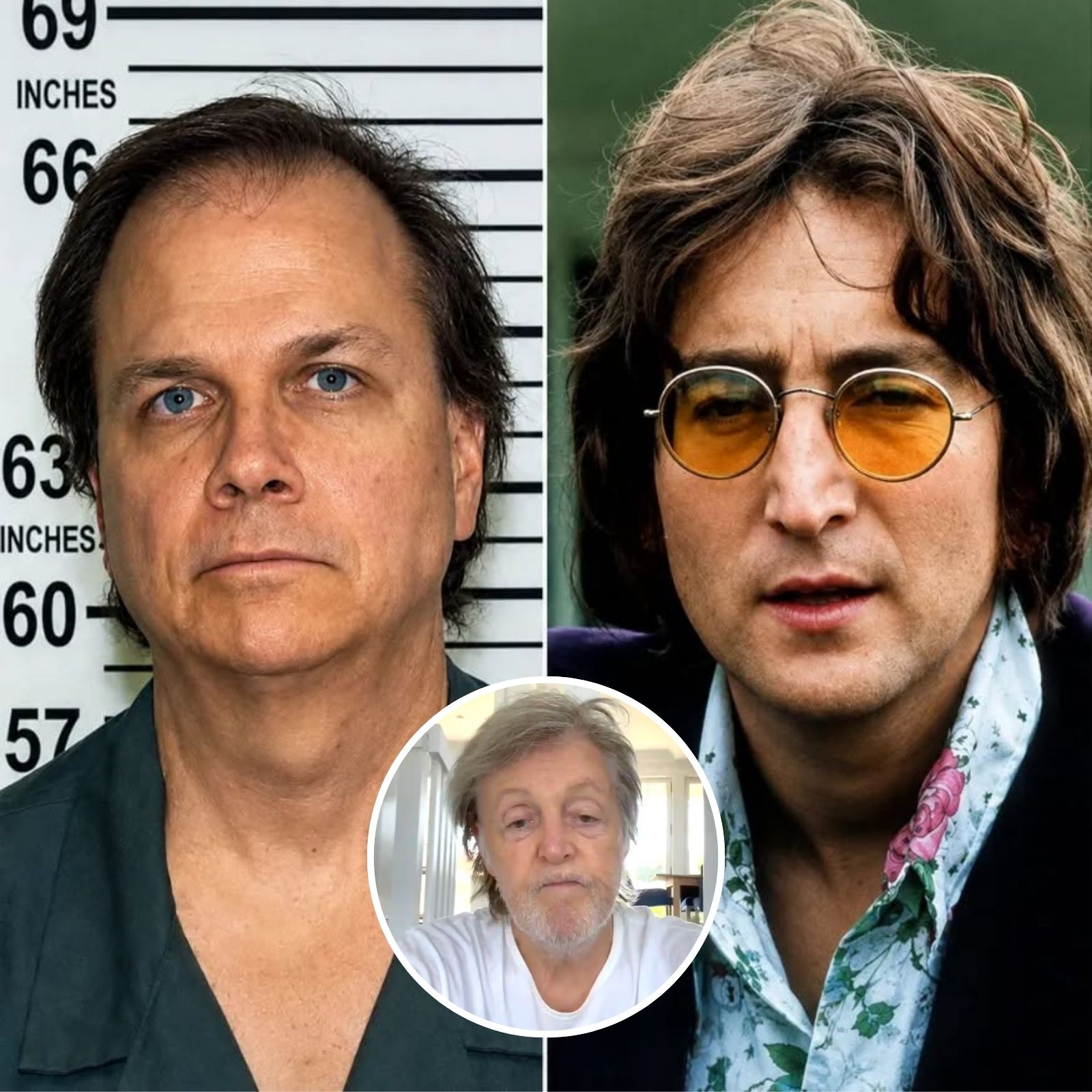
More than four decades after John Lennon was murdered outside his New York home, the question of whether the man who killed him should ever be released remains painfully alive. Mark David Chapman, serving a 20-years-to-life sentence at Green Haven Correctional Facility, was denied parole for the 14th time after an August 27, 2025 hearing. His next parole hearing is scheduled for February 2027, meaning the possibility of release will once again force the public to confront a wound that has never fully closed.

For Paul McCartney, Lennon’s death was never simply a headline in music history. It was the violent loss of a friend and creative partner. In 2018, while joining the March for Our Lives demonstration in New York, McCartney described Lennon as “one of my best friends” and said his death from gun violence was why the issue mattered personally to him. Behind those words stood decades of grief.
Lennon was only 40 when Chapman shot him on December 8, 1980, outside the Dakota apartment building where Lennon lived with Yoko Ono. Earlier that day, Lennon had signed a copy of Double Fantasy for Chapman. Hours later, McCartney lost someone whose presence had shaped his life since their teenage years in Liverpool.

Paul and John’s relationship had never been uncomplicated. They were friends, rivals, collaborators and, at times, two men separated by pressures surrounding the breakup of the world’s most famous band. Yet McCartney has continued carrying Lennon into public memory through stories, performances and songs, most famously “Here Today,” his deeply personal musical conversation with a friend who was no longer there.
That is why the debate surrounding Chapman’s parole reaches beyond a legal proceeding. Parole raises questions about rehabilitation, remorse, public safety and the nature of the crime. Chapman has expressed remorse in previous hearings and acknowledged that his desire for fame drove him to take Lennon’s life. Yet he has been denied release repeatedly, while Yoko Ono has historically opposed his parole and expressed concern about safety for herself and her family.
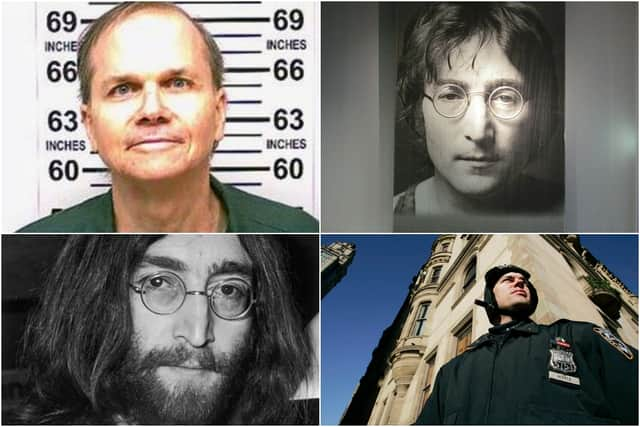
For fans, the issue remains emotionally divided. Some believe that after more than four decades behind bars, rehabilitation means parole must at least remain possible. Others argue that the deliberate nature of Lennon’s murder, its devastation of his family and the enormity of the life taken make permanent imprisonment the only acceptable outcome. There is no easy answer because parole asks society to weigh two ideas at once: whether a person can change, and whether some actions create consequences that time cannot erase.
McCartney himself has not publicly announced a position on Chapman’s next parole hearing. What he has made clear is that Lennon’s death remains personal. The loss lives inside his music and memories, surfacing whenever he speaks about their youth, their songwriting partnership or the future they never had the chance to share. His presence at a gun-violence march decades after Lennon’s death showed how deeply that night remained connected to his own understanding of loss.

Perhaps that is what makes February 2027 feel like more than another date on a prison calendar. Every parole hearing brings December 1980 back into view, forcing Lennon’s family, friends and admirers to revisit a night they would rather have never experienced. It raises questions about justice and forgiveness, but also about what forgiveness means. Forgiving someone does not necessarily mean forgetting the harm or believing there should be no consequences.
Paul has spent more than forty years doing something quieter than answering that question. He has kept John alive in the place where their bond was strongest: the music. Every time “Here Today” is performed, every Beatles memory is retold, and every new generation discovers Lennon and McCartney together, the act that ended John’s life fails to become the final word on who he was.
Parole may remain a legal possibility. But the friendship, memory and music John Lennon left behind have already proved far more enduring than the violence that tried to silence them.