For more than five decades, Bonnie Raitt has built the kind of career that cannot be measured simply by record sales, trophies or nights beneath bright stage lights. Her influence lives somewhere deeper — in the aching honesty of a lyric, the unmistakable cry of her slide guitar, the musicians who grew up studying her records and the listeners who found pieces of their own heartbreak inside songs like “I Can’t Make You Love Me.” So when social media posts recently began celebrating Raitt as one of TIME magazine’s “100 Most Influential People of 2026,” fans responded as though an overdue recognition had finally arrived. There is, however, an important distinction: Bonnie Raitt does not currently appear on TIME’s official 2026 TIME100 list, meaning the viral claim should not be treated as confirmed.

Yet perhaps the speed with which people embraced the story reveals something meaningful about Raitt’s place in American music. For countless admirers, the idea did not sound surprising because influence has defined nearly every chapter of her life. Raitt emerged in the early 1970s with a sound deeply rooted in blues, folk and R&B, refusing to become whatever the music industry might have considered easiest to market. In a world where female guitarists were still too often treated as exceptions, she walked onstage with a bottleneck slide, remarkable technical skill and a voice that could turn vulnerability into strength without ever sounding theatrical.

Her journey was not a straight climb toward fame. There were years when commercial success seemed uncertain, followed by one of music’s great career transformations with Nick of Time. The album became a No. 1 success and helped Raitt win major Grammy recognition, bringing a musician who had already spent years earning the respect of her peers to an enormous new audience. The Recording Academy credits Raitt with 13 Grammy wins across her career, while her achievements include Album of the Year for Nick of Time and, decades later, Song of the Year for “Just Like That.”
That 2023 Song of the Year victory seemed almost perfectly suited to everything Bonnie Raitt has always represented. “Just Like That” was not constructed around spectacle or a passing trend. It was an intimate story about grief, compassion and the mysterious ways love can survive devastating loss. TIME itself wrote about why Raitt’s unexpected Grammy victory mattered, noting the deeply personal storytelling behind the song and the influence she has had on younger artists.

Her music, however, is only one part of the story. Raitt has spent decades connecting artistry with conscience, supporting environmental, social and humanitarian causes rather than treating activism as something separate from her public life. When she was selected as a 2024 Kennedy Center Honoree, the institution described her not only as a singer, songwriter and guitarist but as a distinctive artist whose work blends blues, R&B and other American traditions. The Kennedy Center’s tribute also emphasized how essential activism has been to her identity.
Perhaps that is why Bonnie has remained so deeply respected even as popular culture constantly reinvents itself. She has never needed to become louder simply because the world became noisier. Her power has always come from restraint, emotional truth and the confidence to allow a song room to breathe. When she sings about love that cannot be returned, regret that cannot be undone or hope appearing after unimaginable sorrow, she does not sound as though she is performing someone else’s feelings. She sounds as though she understands them.
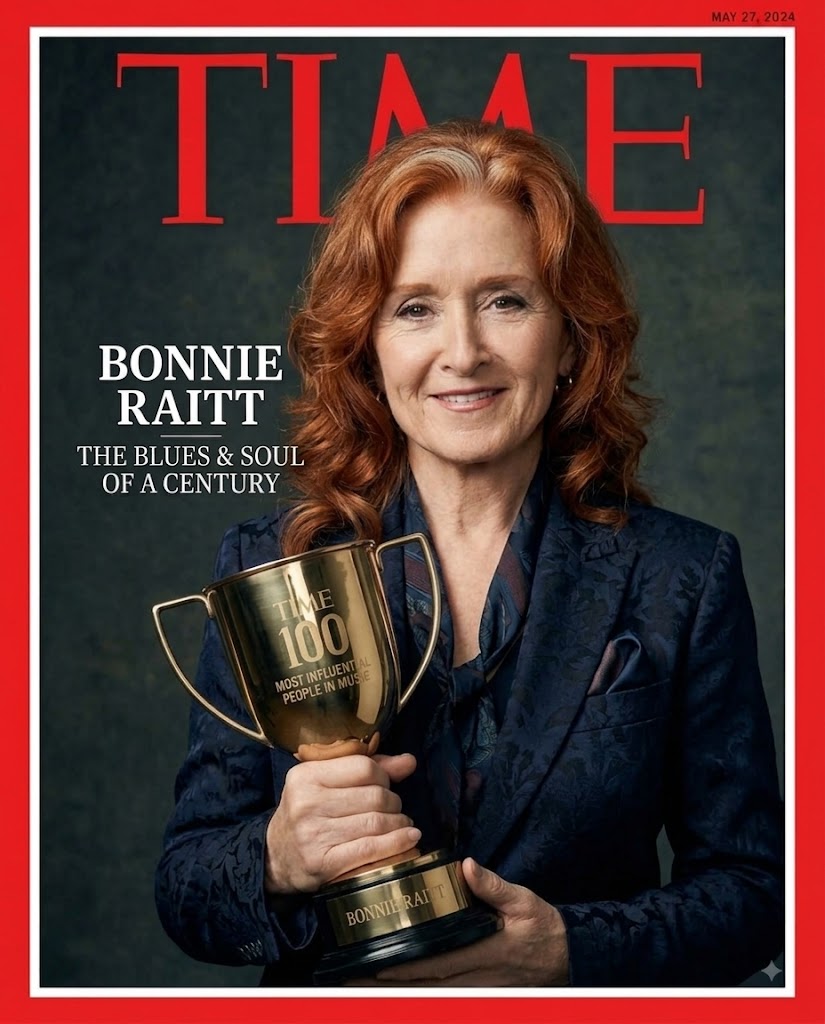
The viral TIME100 claim may not match the magazine’s official 2026 list, but the emotion surrounding it tells its own story. Fans were ready to celebrate because Bonnie Raitt’s influence has never depended on one magazine deciding to recognize it. It can already be heard in generations of singers, guitarists and songwriters who followed her example, and in listeners who still return to her music when ordinary words are not enough.
Some artists leave behind famous songs. Bonnie Raitt has spent more than fifty years leaving behind something harder to define: honesty, courage, compassion and a sound that seems to understand that every human heart eventually learns something about love and loss. Lists come and go, but influence like that has a much longer life.