❤️🇺🇸🎶
Chris Stapleton has never needed many words to make people listen. Onstage, he can turn a single line into something heavy enough to silence an arena, and in an October 2024 interview with The Guardian, he brought that same instinct to a subject far outside the usual territory of heartbreak, whiskey, and country music: politics. Asked about the pressure on celebrities to endorse presidential candidates, Stapleton did not offer a campaign slogan or tell fans how to vote. Instead, he answered with a line that was unmistakably his: “I’m voting for America and a good glass of whiskey.”
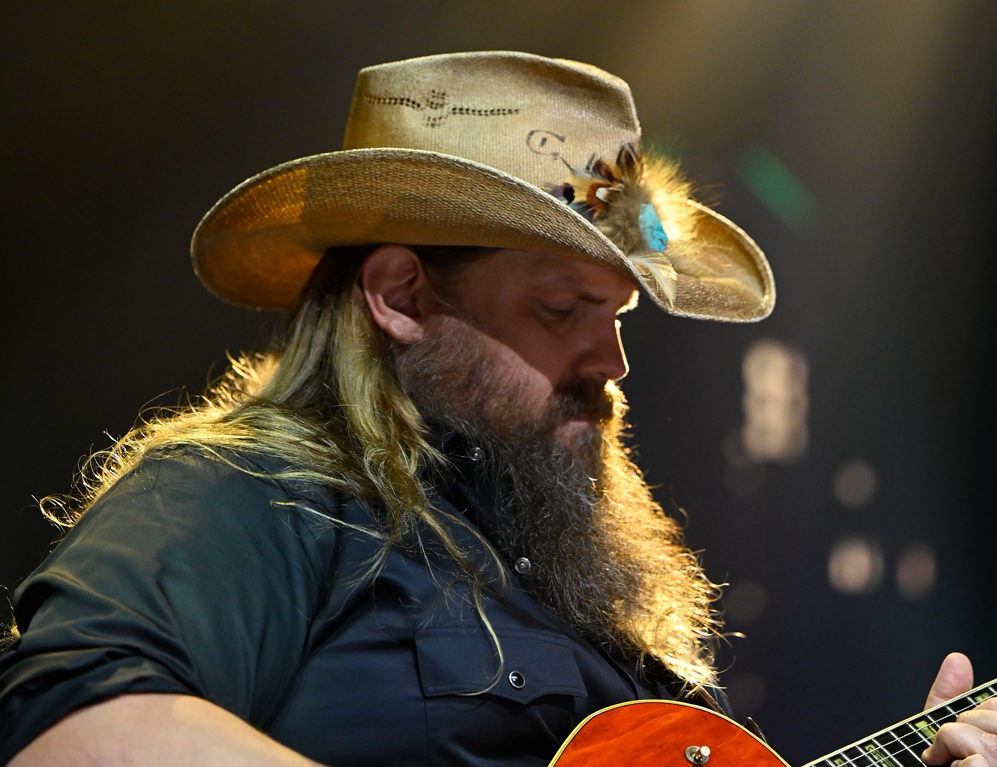
The comment landed because it avoided the red-versus-blue framing that often dominates political conversation. Stapleton made clear that he sees both public political expression and personal privacy as legitimate choices. He told The Guardian that celebrities have every right to endorse candidates if they want to, but he also defended the right to keep a vote private and argued that people should be free to make their own decisions based on what politicians themselves say and do. In a culture where famous people are often expected to declare allegiance publicly, his answer was less about avoiding responsibility than about preserving individual judgment.
That position also connected with something deeper in the interview: Stapleton’s view of what American values mean. He described those values in terms of fairness, standing up for people who cannot always defend themselves, and listening to people whose experiences may be completely different from your own. For him, the point was not that everyone should agree. It was that people who come from different places, backgrounds, and ways of life should still be able to sit down together, listen, and find common ground.

That idea feels especially natural coming from an artist whose audience has never fit neatly into one box. Stapleton grew up in rural Kentucky, became a Nashville songwriter, played bluegrass with the SteelDrivers, moved through Southern rock, and eventually built a solo career that blended country, soul, blues, rock, and R&B. His breakthrough did not come because he perfectly matched one lane. It came because people from very different musical worlds heard something real in his voice. The Guardian noted that his career has become a rare crossover success, with listeners and collaborators extending well beyond traditional country music.

Perhaps that is why his comments about division resonated so strongly. Music has always had the ability to do something politics often struggles to do: put people with different beliefs in the same room without demanding that they agree before they can share an experience. At a Chris Stapleton concert, strangers sing the same chorus, stand beside one another during “Tennessee Whiskey,” and fall silent together when a song reaches the part that hurts. Nobody has to ask the person in the next seat how they voted before the music is allowed to matter.
Stapleton did not present himself as someone with a perfect solution for America’s political divisions. He simply described a set of principles he believes are worth holding onto: fairness, understanding, respect for personal choice, and the willingness to hear someone whose life does not look like yours. He also said that if Americans can still find things they agree on, that is something worth welcoming.
Maybe that is why his answer stood out. It was not built around anger, accusation, or telling millions of people what they should think. It was built around the idea that disagreement does not have to erase connection.
For Chris Stapleton, the message was not that everyone should become the same.
It was that Americans can still find something to share — and sometimes, for a few minutes in a darkened arena, music proves it.