Nearly seven decades after two teenagers crossed paths at Dartford railway station, Mick Jagger and Keith Richards are still doing something nobody could have reasonably imagined in the early 1960s: discussing how The Rolling Stones might step onto a stage again.

Their story has become one of music’s great accidents of fate. Jagger and Richards had known each other as children, but their famous encounter at Dartford station in 1961 changed everything. Keith noticed the blues and rhythm-and-blues records Mick was carrying, conversation followed, and a shared obsession with artists such as Chuck Berry and Muddy Waters helped form the foundation of a partnership that would eventually reshape rock ’n’ roll.
What followed was hardly peaceful.
There were arguments, separations, addictions, scandals, changing band members and periods when the relationship between Mick and Keith seemed almost impossible to repair. Yet somewhere underneath all of it remained a chemistry no replacement could reproduce. Keith could find a riff that sounded as though it had existed forever, while Mick could turn that riff into theater, movement and danger.
Together, the “Glimmer Twins” became the engine behind songs such as “Jumpin’ Jack Flash,” “Gimme Shelter,” “Brown Sugar,” “Start Me Up” and “(I Can’t Get No) Satisfaction.”
Now the question is no longer whether they have anything left to prove.
They clearly do not.
The question is whether they still want one more night beneath the lights.
Richards, now 82, has acknowledged that the traditional touring lifestyle has become increasingly demanding, particularly the constant travel from city to city. But he has also made it clear that retirement from live performance is not necessarily the only option. Speaking about the Stones’ future, Keith raised the possibility of residencies — extended runs in selected cities that would allow the band to perform without enduring the exhausting rhythm of a full-scale world tour.

“I don’t know if tours are possible,” Richards said, explaining that the traveling is what takes the greatest toll. But he immediately offered another possibility: London, New York, Paris or virtually anywhere capable of hosting the Stones for a concentrated series of shows.
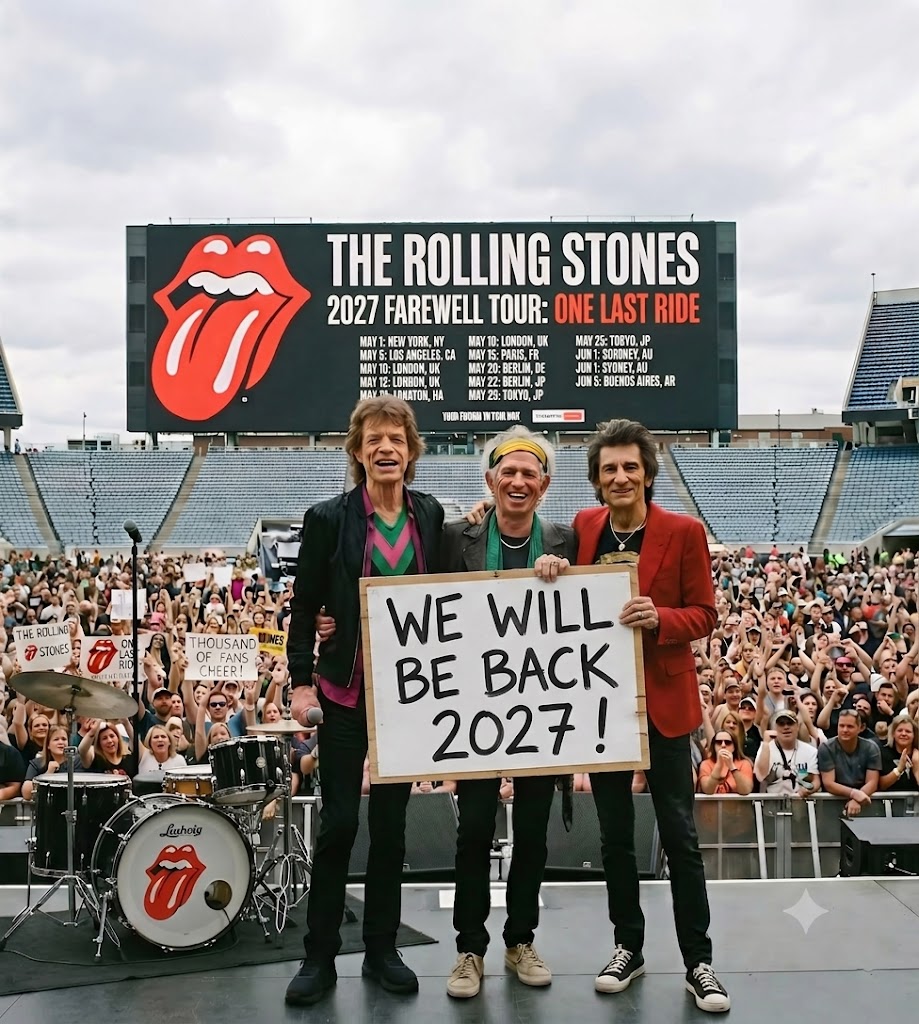
Even more exciting for fans, Richards specifically pointed toward 2027 as a realistic window.
He said discussions were already being “kicked around” and suggested the band might find “a different way” to take the show on the road — or, in classic Keith fashion, make the road come to them.
Mick Jagger appears far less conflicted about performing. He has said plainly that he still likes touring and likes bringing the music directly to audiences. That difference between the two men somehow feels perfectly familiar: Mick restless and ready to move, Keith searching for a way to keep playing without allowing the machinery of touring to consume the experience.

Possible residency scenarios have already sparked enormous speculation. New York naturally stands out, particularly because Richards spends much of his time in nearby Connecticut. London would bring the Stones home to the city where the band began. Los Angeles remains another obvious possibility, while a handful of carefully spaced stadium dates could allow the group to retain the enormous scale of a Stones show without committing to months of travel.
Whatever format emerges, the significance would be impossible to ignore.
The Rolling Stones have not performed a full concert since 2024, and at this stage every future appearance carries the awareness that there cannot be endless next tours. Charlie Watts is gone. Mick and Keith are both in their eighties. Ronnie Wood has spent more than half a century in the band himself.
Time is no longer something lurking somewhere far away.
And yet the Stones keep resisting it.
That may be the most perfectly Rolling Stones ending imaginable — not pretending they are still 25, but refusing to accept that growing older means becoming silent.
The teenagers from Dartford are long gone.
In their place stand two men who have survived nearly an entire history of rock ’n’ roll and somehow remain curious enough to ask the same question they have asked for decades:
Where do we play next?
If 2027 becomes the answer, it will not simply be another Rolling Stones concert.
It will be another impossible chapter in a story that should have ended many times already — and somehow never did.