Only five days after Brian Epstein’s sudden death stunned The Beatles and left the world’s most famous band without the man who had guided them from Liverpool clubs to global superstardom, John Lennon, George Harrison and Ringo Starr gathered at Paul McCartney’s home on Cavendish Avenue in St. John’s Wood. The atmosphere could hardly have been more uncertain. Their manager was gone, the group had already abandoned conventional touring, and for the first time in their extraordinary rise, there was no Brian standing nearby to organize what came next.

Paul, however, already had an idea.
Publicist Tony Barrow had reportedly been asked to arrive early, and during the meeting Paul produced a rough hand-drawn sketch that would become part of Beatles history. It resembled a cake divided into sections, with each segment representing a different sequence or idea for a new film. At the center was a title that sounded almost deliberately mysterious: “Magical Mystery Tour.”
The drawing was simple, but the ambition behind it was enormous.

Rather than returning to the exhausting touring cycle they had abandoned in 1966, Paul imagined using film as a new way for The Beatles to reach audiences. There would be music, surreal comedy, fantasy, strange characters and an unpredictable journey aboard a brightly painted coach traveling through the English countryside. Instead of a tightly scripted movie, much of the project would develop as they went, with different sequences built around songs, visual ideas and whatever happened along the road.
It was an approach perfectly suited to the increasingly experimental Beatles of 1967.
Only months earlier, they had released Sgt. Pepper’s Lonely Hearts Club Band, an album that had demonstrated how far they could travel creatively once they were no longer forced to reproduce every new song onstage. The studio had become their laboratory. Now Paul wanted the camera to become another instrument.

But the timing made the proposal especially remarkable.
Brian Epstein had been much more than a business manager. Since discovering The Beatles in Liverpool, he had helped transform their image, secured recording opportunities, handled the increasingly complex machinery surrounding their fame and provided a sense of structure around four young musicians whose success quickly became almost impossible to manage.
His death at 32 left a vacuum no one was prepared to fill.
John would later speak about how vulnerable the group suddenly felt without him. The Beatles had spent years pushing against management, schedules and expectations, yet Brian’s absence revealed how much stability he had quietly provided.
Paul’s response was to keep moving.
That instinct would become increasingly important — and increasingly complicated — during the final years of The Beatles. When uncertainty threatened to paralyze the group, Paul often proposed another project, another recording session or another creative challenge. Sometimes that energy kept The Beatles together. At other times, his determination could frustrate the others.
With Magical Mystery Tour, both sides of that dynamic were already beginning to appear.
Paul reportedly envisioned filming almost immediately. A coach would be decorated in vivid colors, actors and crew would climb aboard, and the group would travel through England toward Cornwall while scenes were created along the way. Each Beatle could contribute ideas for musical or comic sequences, allowing the film to develop as a collection of strange encounters rather than a conventional plot.
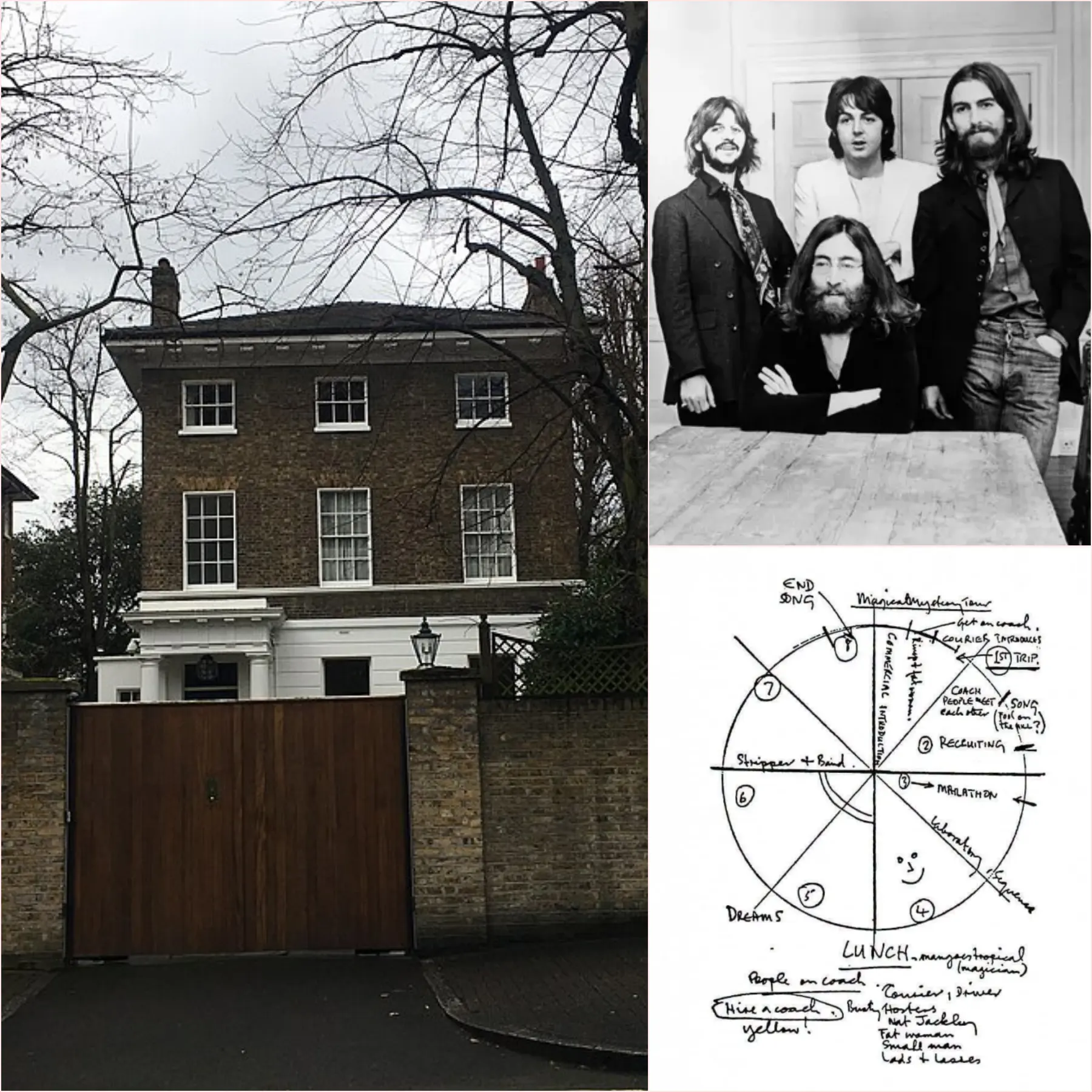
Within days, the plan moved from Paul’s sketchbook into reality.
The result would become one of the most unusual projects in Beatles history. The music produced during the period included songs that endured far longer than the initial controversy surrounding the television film itself, including “I Am the Walrus,” “The Fool on the Hill” and the title track.
Yet the importance of that meeting goes beyond whether Magical Mystery Tour succeeded as cinema.
It marked a turning point.
For years, Brian Epstein had been the adult in the room, the organizer who helped give shape to Beatlemania while the four musicians concentrated on becoming better songwriters and recording artists. Suddenly, that structure was gone, and The Beatles had to decide for themselves what being The Beatles meant.
Paul’s hand-drawn cake was one answer.
It was messy, imaginative, uncertain and perhaps overly ambitious, but it represented movement when the band was surrounded by grief.
Brian Epstein’s era had ended with devastating suddenness.
Five days later, inside Paul McCartney’s London home, the manager-less Beatles were already sketching their way into the unknown.