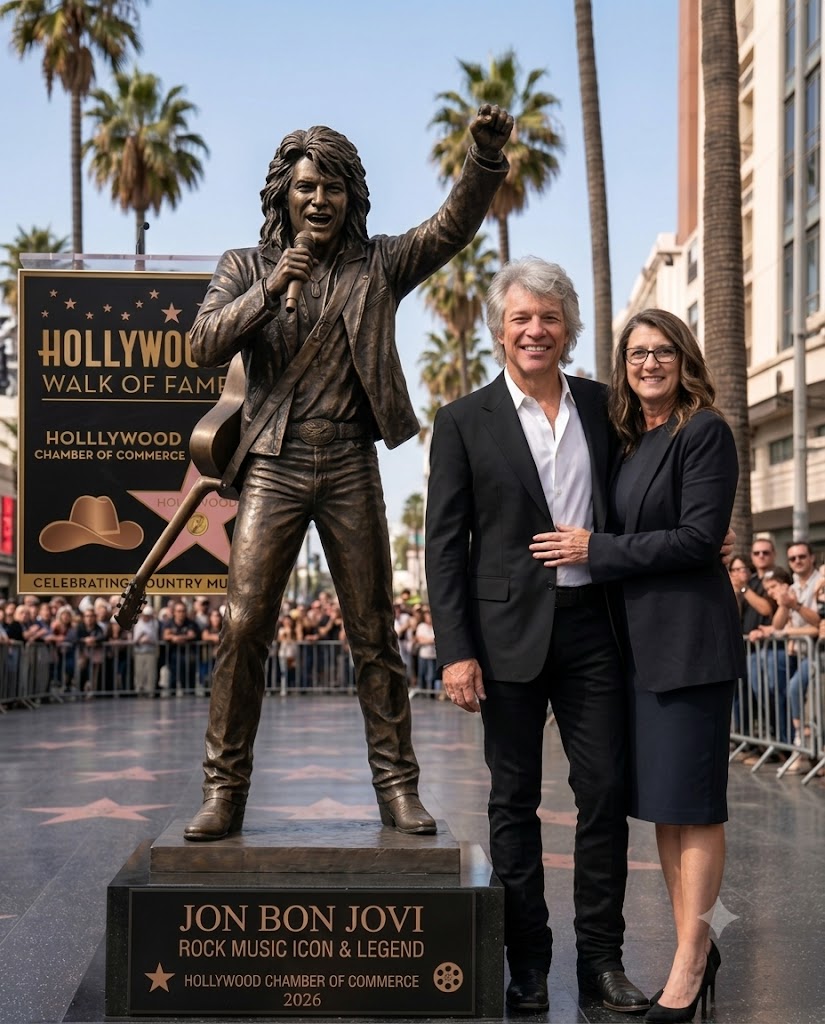
Jon Bon Jovi has spent more than four decades creating the kind of songs that seem built for monuments. “Livin’ on a Prayer” became an anthem of perseverance, “Always” turned heartbreak into one of the band’s most enduring ballads, and “Wanted Dead or Alive” captured the strange mixture of freedom and loneliness that comes with life on the road. So when images and posts began circulating suggesting that the rock legend had become the first icon of his generation honored with a full-body bronze statue on the Hollywood Walk of Fame, the idea immediately felt believable to thousands of fans.
There is only one important problem: Hollywood’s official Walk of Fame has announced no such honor.
The Hollywood Chamber of Commerce, which administers the Walk of Fame, describes the landmark as a collection of terrazzo-and-brass stars embedded along Hollywood Boulevard and Vine Street. Its official database and current ceremony announcements contain no dedication of a full-body Jon Bon Jovi bronze statue, and the recently announced Class of 2027 likewise does not include such an honor.
The confusion may have an understandable connection to a very real Hollywood moment involving Jon.
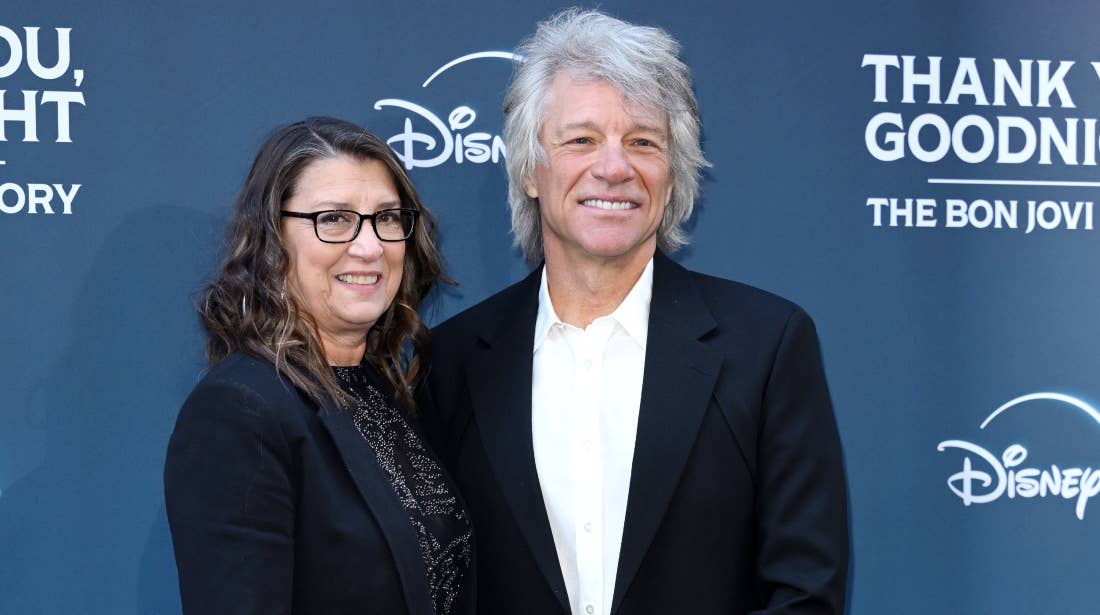
On October 9, 2025, Bon Jovi appeared on the Walk of Fame to help honor his longtime friends in Def Leppard, who received the 2,824th star in the Recording category outside the historic Capitol Records Building. Jon served as one of the guest speakers, celebrating a band whose rise paralleled his own journey through the stadium-rock era.
For fans seeing photographs from that ceremony without context, the image of Jon Bon Jovi standing on Hollywood Boulevard at a major Walk of Fame event could easily take on a life of its own.
But the absence of a bronze statue does little to diminish why the story resonated.
Jon’s legacy already feels monumental because it exists in something much harder to cast in metal: memory.
For generations of listeners, Bon Jovi songs became attached to first cars, school dances, weddings, breakups, long drives and difficult years when “we’ve got to hold on to what we’ve got” sounded less like a lyric than advice. The band’s biggest songs crossed beyond rock radio and became communal experiences, capable of turning tens of thousands of strangers into one enormous choir.
That influence has also survived dramatic changes in popular music.
Bon Jovi emerged during the era of MTV, giant hair, arena guitar solos and physical record sales, yet the songs continued traveling long after that landscape disappeared. Younger listeners discovered them through streaming, movies, parents and viral clips, allowing an anthem written decades earlier to keep finding people who were not even born when it was recorded.
Jon himself has endured through equally dramatic changes.

There were career highs, changing band relationships, family responsibilities and, more recently, serious vocal challenges that forced him to confront the possibility that performing might no longer come as naturally as it once had. His recovery and return to the stage have added another meaning to the resilience fans already heard in his songs.
Perhaps that is why a bronze statue sounded so emotionally satisfying.
A statue suggests permanence.
It says that someone stood here, mattered here and left something behind that deserves to remain after the crowds have moved on.
Jon Bon Jovi has already accomplished that without one.
Hollywood’s actual Walk of Fame ceremonies continue honoring artists with its traditional stars; as recently as October 2026, Air Supply received the 2,859th star in the Recording category. Jon has not been officially unveiled as a bronze figure beside them, but his presence on Hollywood Boulevard in 2025 showed that he already occupies a respected place among the artists whose careers helped define an era.
So the viral statue story may not be literally true.
The feeling behind it is easier to understand.
Fans are not simply looking for another award for Jon Bon Jovi.
They are looking for a physical symbol of something they already believe: that the boy from New Jersey who sang about Tommy and Gina became more than a rock star.
He became part of people’s lives.
And no bronze statue is required to make that legacy stand still. ❤️🎸