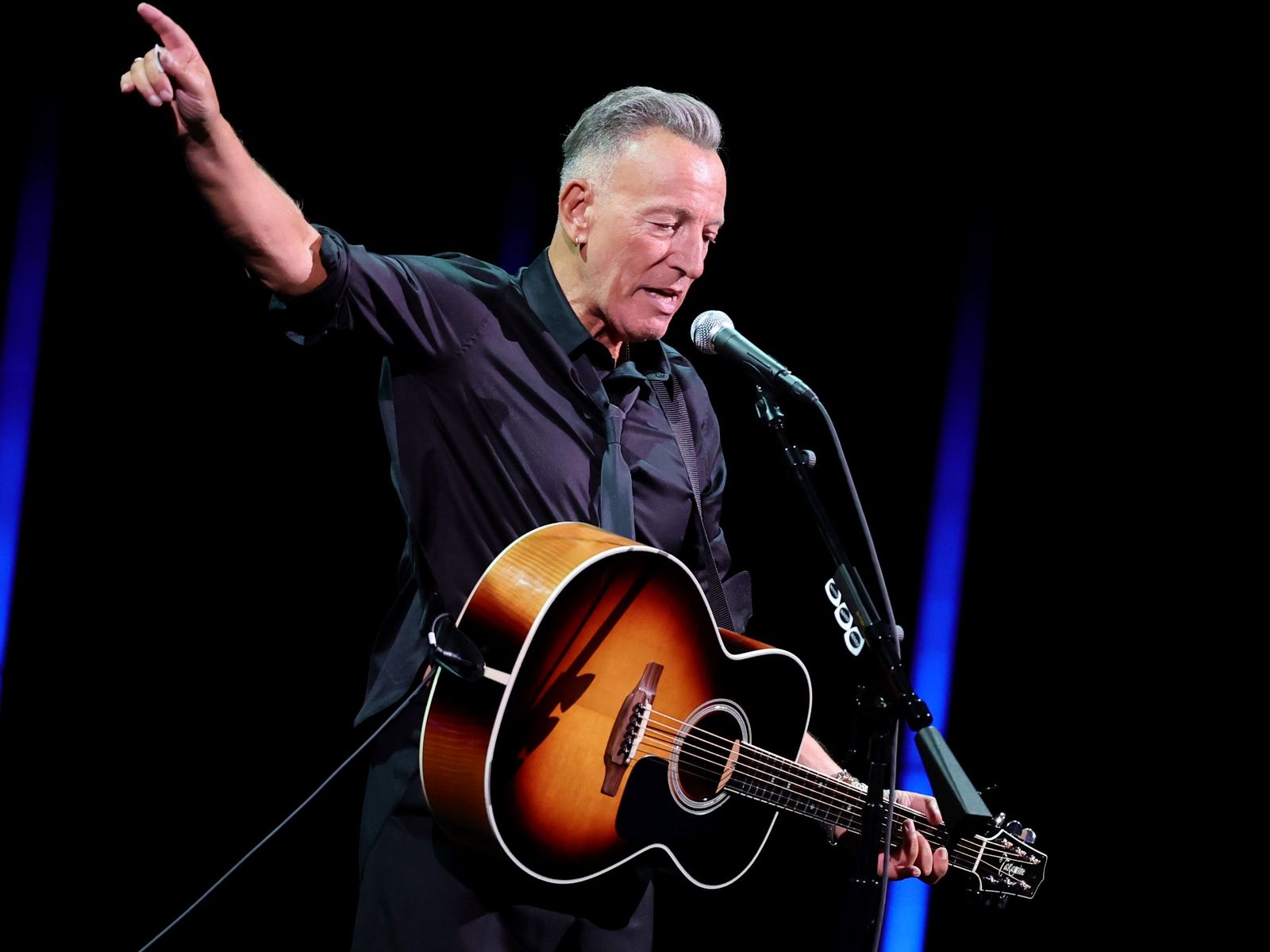
After the concert in Minneapolis had ended and the final notes faded into the rafters, Bruce Springsteen stepped forward and transformed what might have been a routine encore into a moment of reflection that held the entire arena in silence. The transition was subtle but unmistakable, as the energy of performance gave way to something more deliberate, more personal, and ultimately more enduring than any song that had come before it that night.

Springsteen began by acknowledging the weight of the moment, speaking in a tone that carried both steadiness and urgency, as he addressed what he described as a growing sense of distance between people. He reflected on how that divide can deepen over time, shaping not only communities but the emotional fabric of everyday life, and warned that such separation has the power to darken the soul if left unchallenged. His words were not delivered as a lecture, but as a shared concern, framed by the understanding that the audience before him was living through the same uncertain times.
“These are the hard times, but we’ll make it through. We’re the Americans.”

He continued by pointing to the role of disagreement in the country’s history, emphasizing that conflict of ideas has always been part of its foundation, yet insisting that it need not come at the cost of humanity or dignity. In doing so, he drew a clear distinction between disagreement and division, urging listeners to recognize that unity does not require uniformity, and that respect can exist even in the presence of opposing views.
“America, from the beginning, was born out of disagreement. It was built on disagreement. We can argue about what course we think the country should take while recognizing our common humanity, our dignity and, yes, our unity.”
As the arena grew quieter, Springsteen shifted his focus to Renée Good, invoking her name with a reverence that immediately changed the emotional tone of the moment. He spoke of her final words with care, recounting them not as a distant headline, but as a human moment that demanded to be remembered in its full weight and meaning. The story unfolded slowly, allowing the audience to absorb each detail as it was spoken.
“I go back to thinking about Renée Good’s last words before she died, to the man she was protesting against, the man who would take her life. She said, ‘That’s fine, dude, I’m not mad at you. I’m not mad.’ God bless her.”
The silence that followed was complete, as if the arena itself had paused in recognition of what had just been shared. In that stillness, the distance between performer and audience seemed to disappear, replaced by a collective awareness that the moment had moved beyond entertainment and into something more profound.
Springsteen did not allow the moment to remain only in remembrance, instead guiding it toward action by encouraging the audience to carry its meaning beyond the walls of the venue. His words shifted from reflection to responsibility, offering a path forward that emphasized both intention and compassion.
“So tonight, when you go home, hold your loved ones close. And tomorrow, do as Renée did, find a way to take aggressive, peaceful action to defend our country’s ideals.”
He then invoked the legacy of civil rights leader John Lewis, connecting past struggles to the present and reinforcing the idea that meaningful change often begins with individual action. The reference was both historical and immediate, bridging generations through a shared call to engagement.
“Go out and get into some good trouble. Say something. Do something. Help! Sing something!”
As he spoke, Springsteen acknowledged the emotional weight many in the audience were carrying, naming feelings of helplessness, frustration, and anger not as weaknesses, but as realities that needed to be confronted and transformed. In doing so, he positioned the concert itself as part of that response, explaining that the gathering was not merely planned entertainment, but a space for mutual support and renewal.
“That’s why The E Street Band is here tonight. This is a tour that was not planned. We’re here tonight because we need to feel your hope, and your strength. And we want to bring some hope and some strength for you. I hope we did that.”
By the time he reached his closing words, the atmosphere in the arena had shifted entirely, moving from the high energy of a live performance to a shared sense of reflection that extended beyond the music. His final statements were delivered not as a conclusion, but as a quiet offering, grounding the moment in gratitude and remembrance.
“All I can say is God bless Alex Pretti, God bless Renée Good, God bless you, and God bless America.”
There was no immediate rush of applause, no sudden return to spectacle, only a lingering silence that spoke to the depth of what had just been experienced. In that pause, it became clear that the night would not be remembered solely for its songs, but for the message that followed them, a reminder that even in a crowded arena, a single voice can still bring people together, if only for a moment, around something that matters.