▶ Watch the full video at the end of the article.
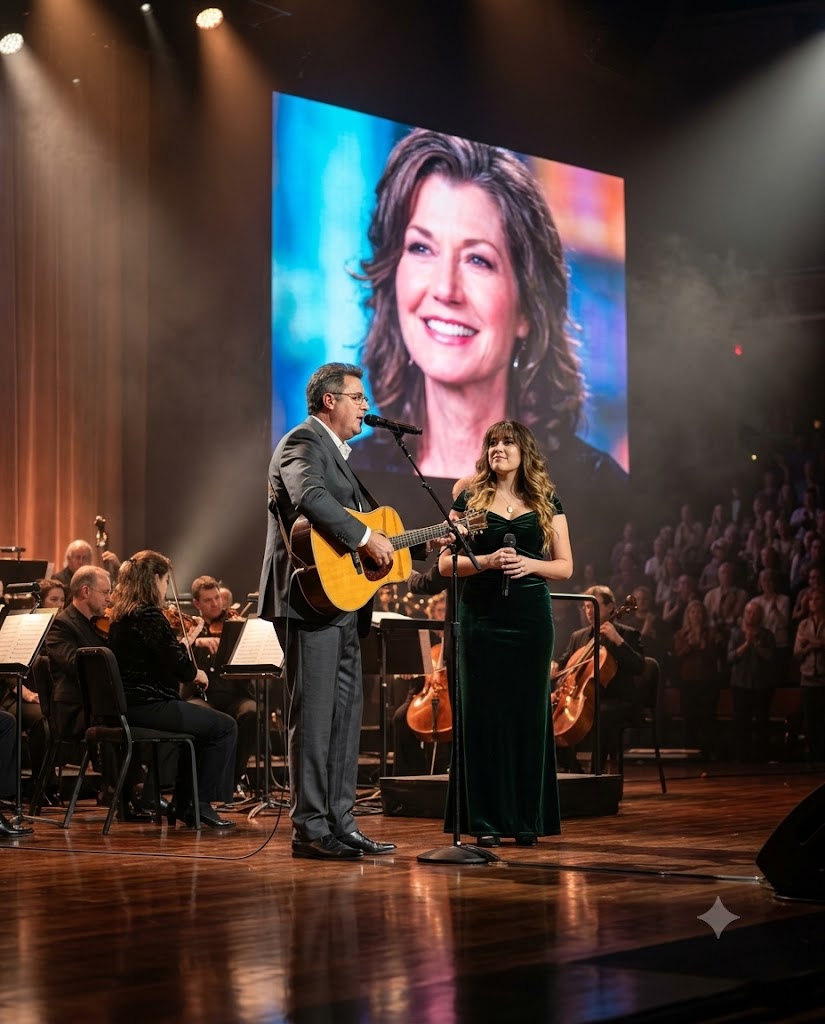
Just over a week after Amy Grant was rushed to the hospital following a frightening bicycle accident in Nashville, Vince Gill walked onto the stage of the historic Ryman Auditorium carrying something far heavier than his guitar. His wife was at home recovering, their family was still processing what had happened, and nobody yet knew exactly how long the road back would be. Then Vince invited their 21-year-old daughter, Corrina Grant Gill, to join him for a song he had originally written about Amy’s faith. What followed became one of the most intimate family moments ever witnessed on that famous Nashville stage.

Amy’s accident happened on July 27, 2022, when she hit a pothole while cycling and was thrown from her bicycle despite wearing a helmet. She was knocked unconscious for approximately ten minutes and initially treated for a concussion, cuts and bruises. In later years, Amy would explain that the accident caused a traumatic brain injury that affected her memory, balance and ability to process conversations, turning what initially sounded like a frightening fall into a much longer journey of neurological recovery.

Vince canceled several concerts immediately after the accident to remain close to his wife. When he was able to return for a four-night residency at the Ryman the following week, Amy was clearly still at the center of his thoughts. During one of those performances, Vince told the audience that his family had been thinking about her constantly and introduced Corrina, the youngest child he and Amy share, to sing “When My Amy Prays.” The song, released on Vince’s 2019 album Okie, had already earned him a Grammy Award for Best Country Solo Performance. That night, however, awards meant very little.
Corrina stepped to the microphone while her father remained behind her with his guitar. Then she made one small change that transformed the entire song.
Instead of singing “When my Amy prays,” Corrina sang “when my mama prays.”

Almost immediately, the emotion became difficult to contain. Corrina choked up early in the performance and briefly apologized to the audience before gathering herself and continuing. The crowd responded with supportive applause, while Vince stayed close, allowing his daughter to carry a song that suddenly belonged not to a husband singing about his wife, but to a daughter singing for her mother during one of the most frightening weeks their family had experienced.
That change of a single word revealed why the performance has remained so powerful. “When My Amy Prays” was always deeply personal, inspired by Vince’s admiration for Amy’s faith and the differences between their spiritual journeys. But inside the Ryman that night, the song became a prayer in another sense — an expression of love from two people who could not heal Amy themselves and could only stand together, make music and hope.
The years that followed revealed just how difficult Amy’s recovery had been. She later admitted wondering whether she would ever feel completely like herself again. Vince became the steady presence beside her, encouraging her to take life one day at a time. Amy has said that his support made the journey bearable, while Vince has described watching her face repeated health challenges with remarkable strength and grace.
By 2026, Amy was speaking openly about the lasting effects of the brain injury. Her processing had changed and patience remained necessary, but her balance had significantly improved. She even returned to a bicycle in a safe environment, an experience she described as deeply emotional. Her album The Me That Remains grew partly from processing the accident and rediscovering her creative identity after years of recovery.
That makes the Ryman performance even more moving in retrospect. Corrina and Vince did not know exactly what Amy’s recovery would look like when they stood together beneath those lights. They only knew someone they loved was hurting.
For a few minutes, country music became something smaller and more important than entertainment. It became a husband, a daughter and a song carrying love toward a woman who could not be there.
And when Corrina changed “Amy” to “Mama,” everyone in the room understood that they were no longer simply listening to Vince Gill’s song. They were witnessing a family pray in the language they knew best — music.