What began as a political flashpoint quickly turned into a cultural moment, as calls to boycott Bruce Springsteen appeared to have the opposite effect, drawing even more attention to his latest release and reigniting conversations about the power of music in times of tension.

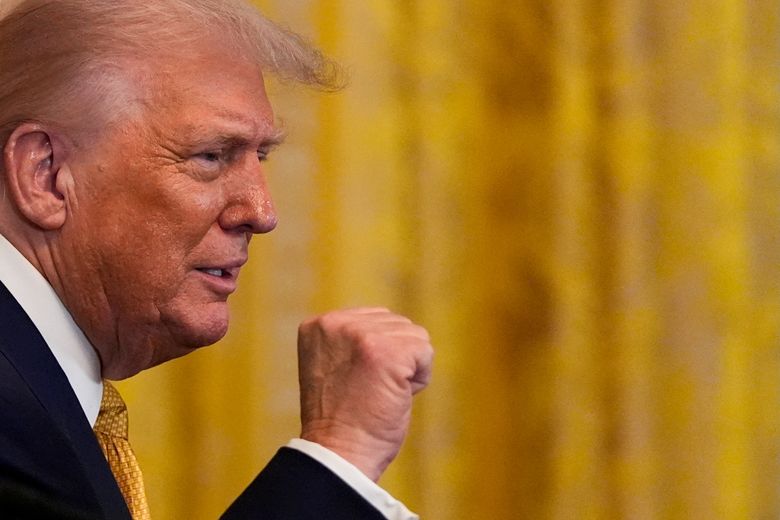
The controversy emerged after Donald Trump suggested that audiences should turn away from Springsteen, a move that might have once been expected to divide listeners or dampen interest. Instead, the reaction from many fans took a different direction.
“So I just bought his latest song on iTunes.”
The statement, simple and direct, began circulating widely, capturing a sentiment that seemed to resonate with a growing number of listeners. Rather than stepping back, they stepped in, choosing to engage with the music in a way that felt both personal and deliberate.
Observers quickly noted the irony.
In an era shaped by rapid response and digital amplification, attempts to suppress attention can sometimes produce the opposite outcome. What might once have been a quiet controversy instead became a catalyst, pushing the conversation further into public view.
Some reactions even took on a more pointed tone.
“The best hope you can have in the entertainment industry is to get a ban from Trump.”

While framed as humor, the remark reflected a broader dynamic, highlighting how cultural influence and political discourse often intersect in unexpected ways. It suggested that visibility, even when driven by criticism, can translate into renewed interest and engagement.
At the center of the moment is Springsteen’s song “Streets of Minneapolis.”
The track has drawn attention not only for its musical qualities, but for the themes it explores, touching on memory, loss, and the complexities of a specific moment in time. Its lyrics carry a weight that extends beyond melody, inviting listeners to reflect on events and experiences that remain deeply relevant.
CHORUS
Oh, our Minneapolis, I hear your voice
Singing through the bloody mist
We’ll take our stand for this land
And the stranger in our midst
Here in our home, they killed and roamed
In the winter of ’26
We’ll remember the names of those who died
On the streets of Minneapolis

For many listeners, the song resonates as more than a composition.
It functions as a form of expression, a way of engaging with themes that are often difficult to articulate. Its impact lies not only in its sound, but in the way it connects individual experience with broader narratives.
The response to the boycott call has underscored this connection.
Rather than isolating the artist from his audience, it appears to have reinforced the relationship, drawing attention to the role that music can play in shaping and reflecting public sentiment. In this context, the act of listening becomes more than entertainment; it becomes a form of participation.
Industry observers note that this pattern is not entirely new.
Artists who engage with social or political themes have long navigated complex reactions, balancing expression with audience response. What has changed is the speed and scale at which those reactions unfold, creating moments that can quickly expand beyond their original context.
For Springsteen, the situation aligns with a career defined by engagement.
He has consistently used his platform to explore themes connected to identity, community, and the realities of everyday life. This latest moment, while shaped by external factors, fits within that broader trajectory, reinforcing the idea that his work is often as much about reflection as it is about performance.
At the same time, the response highlights the evolving relationship between artists and audiences.
Listeners are no longer passive recipients of music, but active participants in how it is received and interpreted. Their reactions, whether through purchasing, sharing, or discussing, contribute to the way a moment is understood.
As the conversation continues, the significance of the situation extends beyond a single song or statement.
It raises questions about influence, visibility, and the ways in which cultural and political dynamics intersect. It also highlights the unpredictability of public response, where intended outcomes can shift in unexpected directions.
In the end, what began as a call for silence has resulted in something else entirely.
More attention.
More conversation.
And more people listening.
Because in moments like this, the relationship between message and audience becomes clear.
What is challenged is not always diminished.
Sometimes, it is amplified.
And for Bruce Springsteen, that amplification has once again placed his music at the center of a conversation that extends far beyond the song itself.