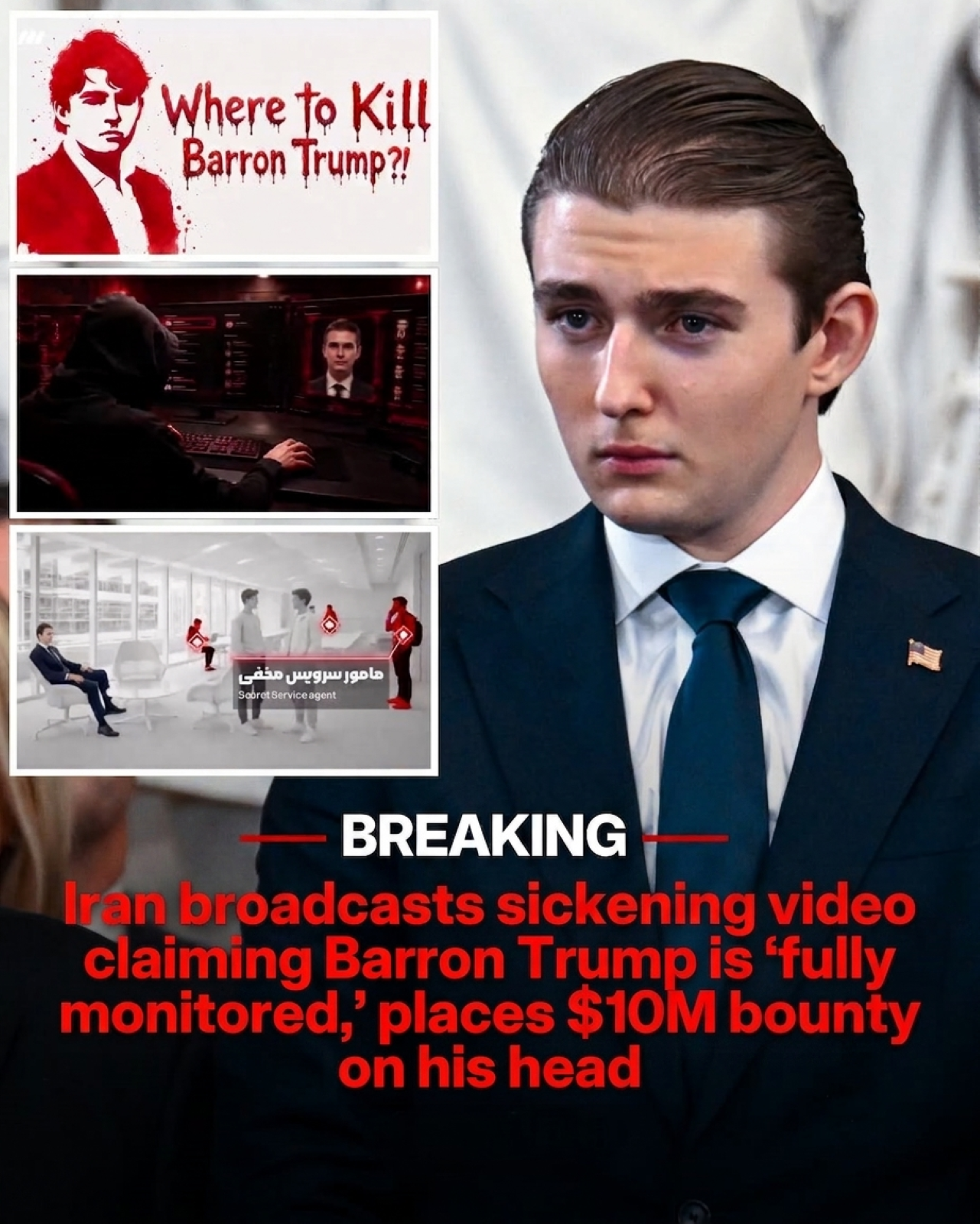
A disturbing escalation between Tehran and Washington has placed President Donald Trump’s youngest son directly in the spotlight. Iranian state television has broadcast a roughly three-minute video targeting 20-year-old Barron Trump, claiming that his movements are being “fully monitored” and referring to a $10 million reward connected to him. The segment, aired on Channel 3 and circulated through media affiliated with Iran’s Islamic Revolutionary Guard Corps, went far beyond ordinary political rhetoric, presenting Barron not simply as the son of an American president but as an individual to be tracked and threatened. The $10 million bounty claim has not been independently verified, but the broadcast itself has been reported internationally.

The video carried an explicitly threatening title asking where and how Barron Trump should be killed. It used stylized surveillance imagery and purported to show knowledge of places he frequents, online activity and the protective presence around him. Rather than repeat operational details that could add to the danger, what matters is the message the broadcast was designed to send: Iranian state-linked media wanted viewers to believe that even the president’s immediate family could be reached. Euronews reported that the programme alleged Barron’s movements were “fully monitored,” while Iran International described the segment as an unusually explicit threat against a member of the U.S. president’s family.
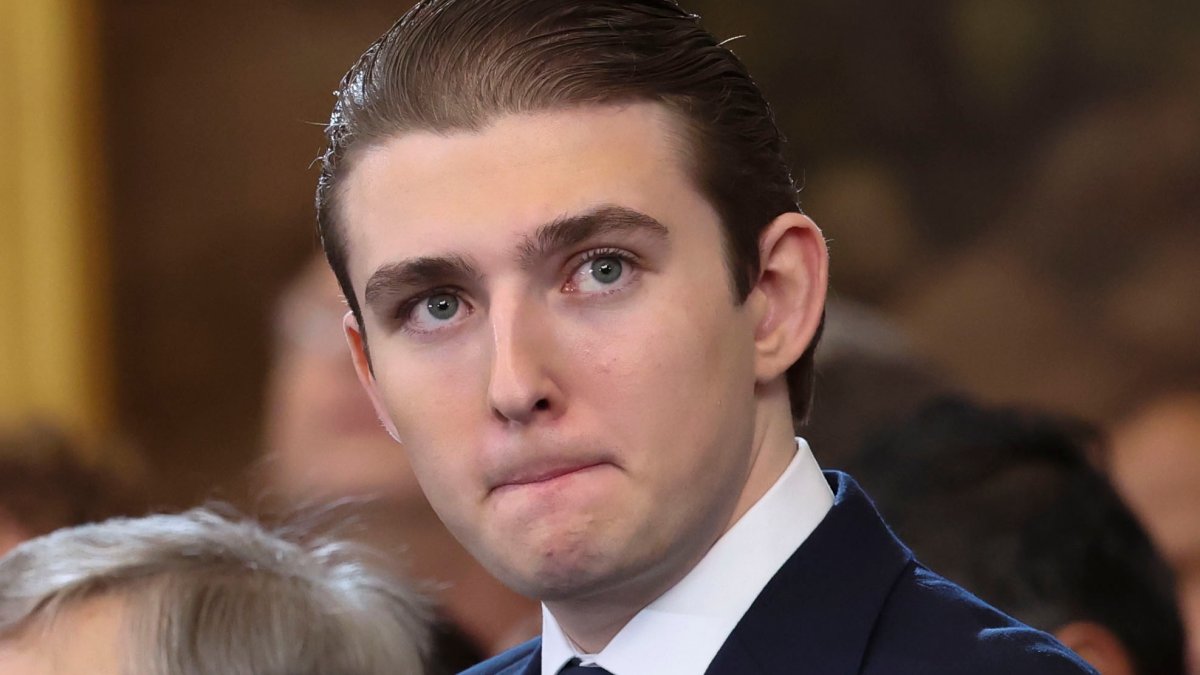
Barron has largely remained outside the political role occupied by his father. Though his name inevitably attracts attention because he is the president’s son, much of his recent public life has centered on college and family rather than holding office or shaping U.S. policy. That contrast has made the broadcast unsettling. Whatever the political conflict between Washington and Tehran, targeting relatives with violent propaganda marks a different and deeply personal form of escalation.
The Barron video also did not appear in isolation. Iranian state-linked media have previously circulated threatening material involving First Lady Melania Trump, while other imagery and commentary have directly targeted President Trump himself. The latest broadcast therefore appears to fit into a broader pattern of intimidation aimed at the Trump family as tensions between the United States and Iran remain high.

Those tensions have grown out of years of confrontation, including the 2020 U.S. strike that killed Qassem Soleimani, commander of the IRGC’s Quds Force, and the recent conflict that followed the February 2026 death of Iran’s Supreme Leader Ayatollah Ali Khamenei in U.S.-Israeli strikes. Iranian officials and state-media figures have repeatedly used the language of retaliation, while Trump has issued severe warnings about what would happen if Iran attempted to assassinate him.
What makes this moment so alarming is the shift from broad threats against governments to imagery centered on an individual family member. A political struggle between nations is one thing. A state television segment appearing to fantasize about killing a president’s son carries an entirely different emotional and security weight.
The claim of a $10 million bounty remains just that — a claim repeated in the Iranian broadcast and not independently established. But even without proof that such money has actually been offered, the existence of the televised threat has already become the story. It sends a message of intimidation at a moment when both sides are using increasingly severe language and when every provocation risks deepening an already dangerous confrontation.
For Donald and Melania Trump, the geopolitical crisis has now been pulled painfully close to home. Barron is not merely a name in a diplomatic dispute; he is their son. For Americans watching the confrontation unfold, the video raises a grim question about how far political retaliation can be allowed to reach before rhetoric itself becomes part of the threat.
Whatever comes next between Washington and Tehran, this latest broadcast has crossed into deeply personal territory. The world has seen governments exchange warnings before. Seeing a president’s 20-year-old son singled out in this way is something else entirely — a reminder that when international conflict becomes personal, the consequences can feel frighteningly close.